SEO maps are the backbone of any content strategy that actually compounds over time. If you're evaluating AI-powered tools to build topical authority, the decision comes down to three factors: how fast the tool generates clusters, whether it integrates GEO-optimization natively, and whether it can take a map all the way to published, scheduled content without you touching a single brief. Most tools stop at the map. The best ones don't. This guide breaks down what separates a useful topical map generator from an end-to-end ranking machine, with specific benchmarks and real decision criteria.
What Are SEO Maps and Why Topical Authority Depends on Them
An SEO topical map is a structured blueprint that organizes your content into pillar pages and clusters of subtopics, each targeting long-tail keywords that support a central theme. The goal is to signal to Google and AI search engines that your site covers a subject comprehensively, not just superficially. According to SEOWriting.ai's topical map guide, websites that plan content using structured clusters consistently outperform those publishing isolated articles. The architecture matters as much as the content itself.
Think of a topical map as a content roadmap that tells you exactly what to write, in what order, and how each piece links to the others. Without it, you're guessing. With it, every article reinforces the ones around it, building a web of internal links that search engines can crawl efficiently. This is the foundation of semantic SEO: relevance signals that come from structure, not just keywords. A well-built semantic SEO map can support 6 to 12 months of content planning in a single session.
The practical difference between sites with and without topical maps is measurable. Sites that use structured content clusters fill competitor gaps faster, rank for more long-tail variations, and build domain authority in a specific niche rather than spreading thin across unrelated topics. According to SearchAtlas's topical maps resource, topical authority is now a primary ranking signal, not a secondary one. Google's systems actively reward sites that demonstrate depth on a subject.
For local businesses, the stakes are even higher. A GEO topical map doesn't just organize content by subject. It layers location intent into every cluster, turning a generic topic like "SEO services" into geo-modified subtopics like "SEO services Austin" or "local SEO for restaurants in Chicago." This dual-layer approach captures both broad topical authority and hyper-local search intent simultaneously. That combination is what separates a content strategy that ranks from one that merely exists.

How AI Topical Map Generators Actually Work
The mechanics behind an AI topical map generator are straightforward once you see them in action. You input a primary keyword, select the number of clusters you want (typically 1 to 10), and specify how many long-tail keywords each cluster should target. The AI then analyzes SERP data, extracts subtopics from the top 10 ranking pages, and assembles a full content map with article titles and internal linking suggestions. According to HackTheSEO's topical map generator, this entire process completes in under 60 seconds.
The SERP analysis layer is where the real value lives. Instead of guessing what subtopics matter, the tool reads what's already ranking and reverse-engineers the topical structure that Google rewards. It identifies content gaps, overlapping themes, and keyword variations that a human researcher would take hours to compile manually. This is SERP topical analysis at scale, compressed into a workflow that takes less time than writing a single paragraph.
Once the map is generated, better tools go further. They suggest internal linking structures, flag which clusters to prioritize based on search volume and competition, and even recommend the order in which to publish articles for maximum topical authority accumulation. The output isn't just a list of titles. It's a ranked, sequenced content roadmap that tells you exactly where to start and where to go next.
GEO-Modification in AI-Generated SEO Maps
GEO-optimization in topical maps means the AI automatically appends location modifiers to relevant clusters. A cluster around "digital marketing" becomes "digital marketing for small businesses in Denver." This isn't cosmetic. It changes the keyword intent entirely, targeting searchers who are ready to act locally rather than those browsing broadly. Tools that handle GEO-modification natively save hours of manual keyword research and ensure 100% local intent capture across every cluster they generate.
Key Features That Separate Useful SEO Map Tools from Powerful Ones
Not all topical map tools are built the same. The baseline features, keyword input, cluster generation, and title suggestions, are table stakes at this point. What separates a useful tool from a powerful one is the depth of integration it offers downstream. Can it feed the map directly into a content generation workflow? Does it score articles against SERP benchmarks? Does it support automated publishing and scheduling? These are the questions that matter for anyone building a serious content operation.
"Generated SEO articles from topical maps reach 90+ content scores upon completion, typically within hours to a full day depending on volume." (Source: Agilitywriter.ai research on topical map tools)
Content score optimization is one benchmark worth tracking closely. According to Agilitywriter.ai's review of topical map tools, generated articles from AI-assisted maps regularly achieve content scores above 90 once the full workflow completes. That's not a vanity metric. A content score above 90 means the article covers the topic comprehensively enough to compete with the top results in its SERP. Below 70, you're leaving ranking potential on the table.
The comparison below shows how different tool categories stack up across the features that actually affect ranking outcomes. Use this to frame your evaluation before committing to any platform.
| Tool Category | Map Generation Speed | GEO Optimization | Content Score Target | Auto-Publishing | AI Search Optimization |
|---|---|---|---|---|---|
| Basic Keyword Cluster Tools | 2-5 minutes | Manual only | 60-70 | No | No |
| Mid-Tier SEO Platforms | 60-90 seconds | Semi-automated | 70-80 | Limited | Partial |
| AI Topical Map Generators | Under 60 seconds | Automated clusters | 80-90 | Export only | Partial |
| End-to-End GEO Platforms | Under 60 seconds | Fully automated | 90+ | Yes, with scheduling | Full (Google + AI search) |
| Agency-Managed Services | 3-7 business days | Manual research | Varies | Yes (manual) | Depends on team |
The table makes one thing clear: the gap between a basic cluster tool and an end-to-end GEO platform isn't incremental. It's categorical. A business evaluating these options needs to decide whether they want a research aid or a ranking engine. Those are fundamentally different products, even if they share the label "topical map tool."

How SEO Maps Feed Into End-to-End Content Automation
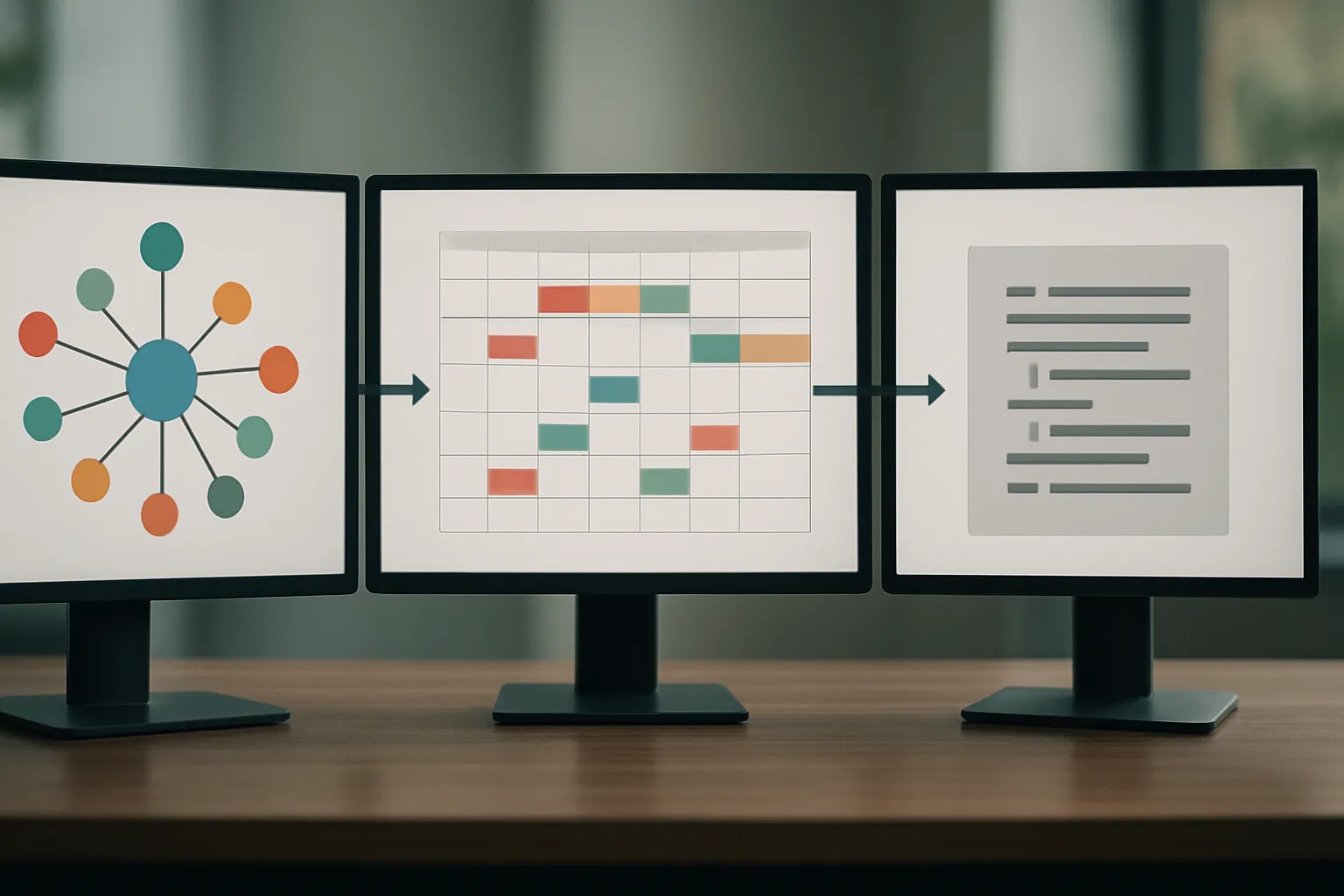
The most significant gap in the current tool landscape is the disconnect between map generation and content execution. Most platforms hand you a map and stop there. You still need to write briefs, assign writers, manage drafts, optimize for SERP, and schedule publication. For a small team or a solo operator, that workflow is the bottleneck. The map is only valuable if the content actually gets produced and published on a consistent schedule.
Get Google, ChatGPT traffic on autopilot by closing that gap entirely. End-to-end platforms like Rankfast take a topical map and run the full workflow: keyword research, GEO-optimized article generation, internal linking, and scheduled publishing, all without requiring manual intervention at each step. The map becomes the trigger for an automated content pipeline, not just a planning document that sits in a spreadsheet.
In practice, this means a business can input a primary keyword, generate a 10-cluster topical map, and have the first batch of articles drafted, scored, and queued for publication within the same session. The content generator analyzes the top 10 SERP results to extract themes and subtopics, ensuring each article covers the subject with enough depth to compete. According to research from TrySight.ai's content generator analysis, AI content generators that analyze SERP data produce articles that rank in both Google and AI search environments.
The scheduling layer is where automation becomes genuinely hands-off. Rather than publishing everything at once (which can look unnatural to search engines) or manually staggering posts, the platform distributes publication dates across weeks or months based on the topical map's priority sequence. This mirrors how a professional content team would operate, but without the overhead. For non-experts who want to rank without becoming SEO practitioners, this is the difference between a tool and a solution.
Building Topical Authority with SEO Maps: A 6-Month Content Strategy
Topical authority doesn't accumulate overnight. It builds through consistent, structured publishing over months. A well-designed topical map supports exactly this kind of long-term strategy by giving you a sequenced roadmap that prioritizes high-impact clusters first, then fills in supporting subtopics as the site gains authority. According to content strategy research cited by multiple SEO practitioners, websites using topical maps can plan 6 to 12 months of content in advance with natural multi-keyword ranking built into every article.
A mid-size SaaS company evaluating these options would typically start with a 3-cluster map targeting their core product category, publish pillar content in the first month, then expand into supporting subtopics over the following quarter. By month six, the internal linking structure creates a self-reinforcing authority signal that individual articles can't replicate. The compounding effect is real: each new article strengthens the ones already published, not just the one being added.
Get Your Brand Mentioned by ChatGPT by building the kind of topical depth that AI search engines use to identify authoritative sources. ChatGPT, Perplexity, and Google's AI Overviews all draw from sites that demonstrate comprehensive coverage of a subject. A topical map that covers a niche from multiple angles, with GEO-modified clusters for local intent, creates exactly the kind of content footprint that AI systems recognize as authoritative.
The ROI timeline for topical map strategies is more predictable than most SEO tactics. Because you're building authority in a structured way rather than chasing individual keywords, the ranking trajectory tends to be steadier. Early articles may take 60 to 90 days to rank. By month four or five, the internal linking structure accelerates indexing and ranking for newer content. In our experience, businesses that prioritize topical depth over keyword volume see faster authority accumulation and more stable rankings over time.
Filling Competitor Content Gaps with a Topic Cluster Builder
One of the most practical applications of a topic cluster builder is competitive gap analysis. By mapping what your competitors cover and what they don't, you can identify entire subtopic clusters that are underserved in your niche. Publishing those clusters first gives you a first-mover advantage in that topical space. AI generators that integrate SERP analysis make this gap-finding process automatic, surfacing opportunities that manual research would miss entirely.
Who Should Use AI SEO Maps and What Results to Expect
The use cases for AI-generated SEO maps span a wider range than most people assume. Agencies use them to onboard new clients faster, generating a full content roadmap in a single meeting rather than spending weeks on keyword research. Content writers use them to understand the full scope of a topic before starting a single article. Local businesses use them to build GEO-targeted content strategies that capture both broad and hyper-local search intent. The common thread is the need to produce structured, authoritative content at a pace that manual research can't support.
For agencies specifically, the efficiency gains are significant. A topical map that would take a senior SEO analyst two days to build manually can be generated in under a minute. That time savings compounds across every client and every content cycle. Agencies that integrate topical map generation into their standard workflow can take on more clients, deliver faster results, and differentiate their service with a data-driven content architecture that most competitors still build by hand.
Local businesses face a different challenge: they often lack the in-house expertise to build or execute a content strategy at all. For them, the value of an end-to-end platform isn't just speed. It's accessibility. A business owner who doesn't know what a content cluster is can still benefit from one if the platform handles the strategy, writing, and publishing automatically. The SEO content roadmap becomes invisible infrastructure rather than a manual process.
Rank on Perplexity, ChatGPT & Google AI Overviews by treating your topical map as a signal to AI search engines, not just Google. Platforms that optimize content for AI search alongside traditional SERP rankings give you coverage across the full discovery landscape. As AI-generated answers become the first touchpoint for more searches, having your content cited in those answers requires the same topical depth that drives traditional rankings. The strategy is the same. The distribution is broader.
Frequently Asked Questions About seo maps
What is a topical map in SEO?
A topical map in SEO is a structured content blueprint that organizes articles into pillar pages and supporting clusters, each targeting related long-tail keywords. SEO maps help search engines understand that a site covers a subject comprehensively, which builds topical authority and improves rankings across an entire keyword cluster rather than for individual terms.
How do you create a topical map for SEO?
You create a topical map by selecting a primary keyword, identifying 3 to 10 subtopic clusters around it, and assigning long-tail keyword targets to each cluster. AI generators automate this process by analyzing SERP data and extracting subtopics from top-ranking pages, producing a full map with internal linking suggestions in under 60 seconds.
What is the best SEO topical map generator?
The best topical map generator depends on your workflow. If you only need a map, standalone generators work well. If you need the map to feed directly into content creation, scheduling, and publishing, an end-to-end platform like Rankfast delivers more value by eliminating the gap between planning and execution. SEO maps are most effective when they connect directly to a content pipeline.
How does AI help with topical authority?
AI accelerates topical authority building by generating comprehensive content clusters faster than manual research allows, identifying competitor gaps, and producing articles that score above 90 on content completeness benchmarks. AI also enables consistent publishing schedules, which is critical for accumulating topical authority over a 6 to 12 month content cycle.
What tools integrate topical maps with content generation?
End-to-end platforms integrate topical map generation with AI article writing, GEO-optimization, internal linking, and scheduled publishing in a single workflow. These platforms take a primary keyword as input and handle everything through to published content, making them the most efficient option for businesses that want to rank without managing a manual content operation.
Summary
- SEO maps build topical authority by organizing content into structured clusters with internal links, supporting 6 to 12 months of content planning and enabling natural multi-keyword ranking across an entire niche.
- AI generators close the research gap by analyzing SERP data and producing full content maps with GEO-modified clusters in under 60 seconds, with generated articles reaching content scores of 90+ upon completion.
- End-to-end platforms eliminate execution bottlenecks by connecting topical maps directly to automated content generation, GEO-optimization, and scheduled publishing for Google and AI search, without requiring manual intervention at each step.
Conclusion
The verdict on SEO maps is straightforward: they work, but only if the content behind them actually gets produced and published consistently. A topical map sitting in a spreadsheet ranks nothing. The tools that deliver real results are the ones that take the map all the way through to scheduled, GEO-optimized articles that appear in both Google and AI search. For agencies, content teams, and local businesses that want to build topical authority without managing every step manually, the right platform isn't just a map generator. It's an end-to-end ranking engine that treats the map as the starting point, not the finish line.