Programmatic SEO is the practice of using automation, templates, and structured data to generate thousands of unique, keyword-optimized pages at scale, targeting long-tail search queries that would take a manual team years to cover. If you have ever wondered how travel platforms publish pages for every hotel in every city, or how e-commerce sites rank for millions of product variations, you are looking at pSEO in action. This guide breaks down exactly what it is, how it works, and how modern AI-powered tools are pushing it further than static templates ever could.
What Is Programmatic SEO and Why It Scales Where Manual SEO Cannot
At its core, programmatic SEO is a system, not a tactic. You identify a repeatable keyword pattern, collect structured data that maps to that pattern, build a flexible page template, and let automation fill in the blanks and publish at volume. The result is hundreds or thousands of unique, indexable pages, each targeting a specific long-tail query, without writing each one from scratch. According to SE Ranking's programmatic SEO guide, this approach is especially powerful because roughly 80% of all searches are long-tail, meaning low-competition queries that individual pages can realistically rank for.
Manual SEO is built for depth. You pick a high-value keyword, research it thoroughly, and craft a comprehensive piece designed to be the definitive resource. That works well for competitive head terms, but it does not scale. A team of five writers cannot produce 10,000 location pages in a quarter. Programmatic search optimization solves the volume problem by treating content as a data output rather than a writing task. The trade-off is that each page tends to be narrower in scope, which is exactly what long-tail searchers want.
The distinction matters because the two approaches are not in competition. They serve different parts of the keyword universe. Template-based SEO captures the long tail at scale, while manually crafted content anchors your topical authority on broader terms. The smartest SEO strategies use both, and increasingly, AI-powered tools are blurring the line between them by generating pages that are both scalable and genuinely substantive.
Is Programmatic SEO the Same as Low-Quality Spam?
This is the most persistent misconception in the space. Done poorly, mass page creation produces thin, repetitive content that search engines penalize. Done correctly, each page delivers real, unique value to a specific searcher. The difference lies in data quality and template design. If your data source is rich and your template surfaces genuinely useful information for each variation, the pages are not spam. They are efficient publishing.
How Programmatic SEO Works: Data, Templates, and Automation Engines
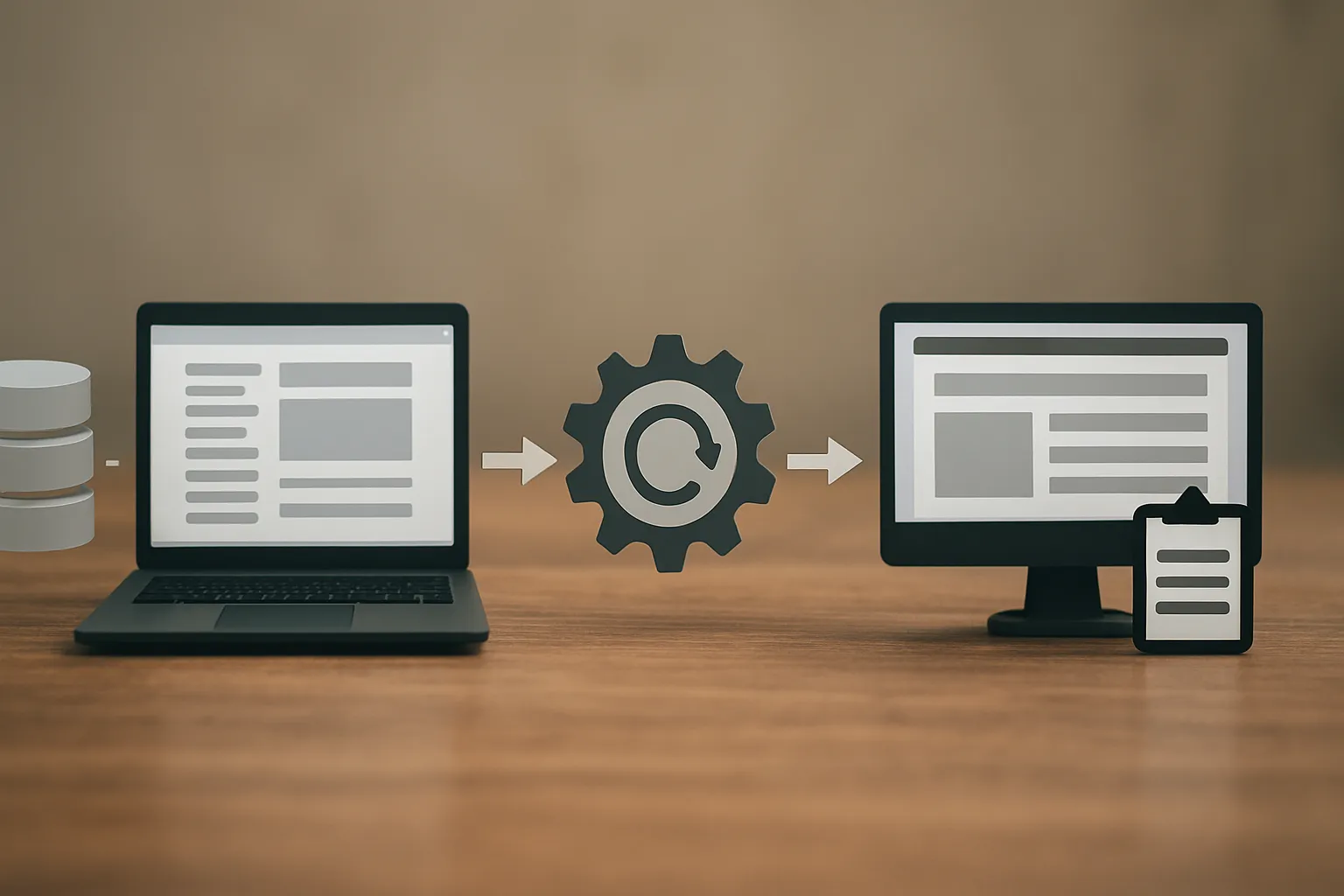
Every programmatic SEO system has three components: a data source, a page template, and an automation engine. The data source is typically a spreadsheet, database, or API feed containing the variables that make each page unique. Think city names, product categories, job titles, or ingredient lists. The template is a page structure with placeholders where those variables slot in. The automation engine connects the two, generates the pages, and publishes them to your CMS or hosting platform.
The automation engine is where modern tools have made the biggest leap. Early programmatic SEO relied on static templates where the same sentence structure repeated with only the variable swapped out. That approach worked until search engines got better at detecting thin content patterns. Today, AI-powered systems generate dynamic, contextually varied content for each page variation, meaning the page for "best running shoes in Austin" reads differently from "best running shoes in Denver," even though both follow the same structural template. Shopify's breakdown of programmatic SEO highlights how e-commerce platforms use exactly this model to manage millions of product pages efficiently.
Scheduling and publishing workflows are the underrated third leg of this system. Generating pages is one thing. Deploying them strategically, in batches that avoid triggering crawl anomalies, with internal linking built in, is another. Tools like Get Google, ChatGPT traffic on autopilot handle this entire pipeline, from keyword discovery to GEO-optimized article generation to scheduled publishing, so the operational burden does not fall on your team.
Real-World Programmatic SEO Examples That Drive Massive Traffic
The clearest example in travel is TripAdvisor. The platform uses a programmatic model to create pages for countless destinations, hotel categories, and attraction types. A query like "things to do in Lisbon" or "budget hotels near Rome airport" returns a TripAdvisor page that was not hand-written by an editor. It was generated from structured data about properties, reviews, and location metadata, assembled by a template, and published at scale. That model drives enormous search traffic volumes across millions of keyword variations that no manual editorial team could cover.
E-commerce is the other obvious domain. Platforms with large product catalogs use dynamic content SEO to create optimized pages for every product variation: size, color, material, use case. A single product with ten attributes can generate dozens of unique landing pages, each targeting a specific long-tail query. A 2024 analysis noted that e-commerce sites with millions of product pages leverage programmatic SEO for efficient on-page optimization at a scale that would otherwise require hundreds of full-time writers.
"Programmatic SEO generates thousands of unique pages using templates and structured data, targeting long-tail keywords that collectively drive more traffic than any single high-volume term could."
Beyond travel and e-commerce, the pattern appears in job boards (pages for every job title in every city), real estate platforms (listings by neighborhood, price range, and property type), SaaS comparison sites (tool A vs. tool B for every combination), and recipe sites (ingredient substitutions, dietary variations). The keyword pattern "best [X] in [Y]" scales to hundreds of variations via automation, and each variation represents a real searcher with a specific intent. That is the core insight behind long-tail keyword scaling.

| Industry | Keyword Pattern | Data Source | Estimated Page Volume |
|---|---|---|---|
| Travel | Hotels in [City] | Property database + reviews | 100,000+ |
| E-commerce | [Product] in [Color/Size] | Product catalog API | 1,000,000+ |
| Job Boards | [Job Title] jobs in [City] | Live job feed | 500,000+ |
| Real Estate | Homes for sale in [Neighborhood] | MLS listings database | 200,000+ |
| SaaS / Tools | [Tool A] vs [Tool B] | Feature comparison dataset | 10,000+ |
5 Steps to Implement Programmatic SEO for Scalable Content
Implementation starts with finding scalable keyword patterns. You are looking for a head modifier combined with a variable: "best [product] in [city]", "[software] for [industry]", "how to [verb] [noun]". The pattern needs to have enough search volume across its variations to justify the build, but not so much competition that programmatic pages cannot rank. Tools that surface long-tail keyword clusters make this step faster, but the strategic judgment of which pattern to pursue is yours.
Once you have a pattern, you need a structured data source that populates the variable. This might be a CSV of 500 city names, a product database with attributes, or an API that returns real-time data. The quality of your data directly determines the quality of your pages. Stale, incomplete, or inaccurate data produces pages that fail users and get filtered out of search results. Invest in the data layer before you build anything else.
- Identify a repeatable keyword pattern with sufficient aggregate search volume.
- Build or source a structured dataset that maps to the variable in your pattern.
- Design a page template with clear placeholders, strong internal linking logic, and unique content hooks per variation.
- Connect an automation engine to generate and publish pages, either via a CMS integration, a headless setup, or a dedicated SEO content generator.
- Monitor indexation and performance by segment, pruning low-performing pages and expanding patterns that gain traction.
The monitoring step is where most implementations fall short. Generating pages is satisfying. Auditing them six months later to find that 40% are not indexed is less so. Build a review cadence into your workflow from day one. Modern AI SEO automation tools can flag indexation gaps and content quality issues automatically, which is a significant operational advantage over manual audits.
AI-Powered Programmatic SEO: GEO Optimization and Scheduled Publishing in 2025
The 2025 shift in programmatic SEO is not just about generating more pages. It is about generating pages that rank in AI-powered search environments, including Google's AI Overviews, Perplexity, and ChatGPT's browsing responses. These systems pull from structured, authoritative content that answers specific queries directly. A well-built programmatic page, with a clear question-answer structure, factual data, and schema markup, is exactly the kind of content AI search surfaces. SEO Clarity's analysis of programmatic SEO notes that modern implementations are shifting toward AI-powered real-time updates, reducing stale content risks by up to 90% compared to static template approaches.
GEO optimization, meaning structuring content so AI systems can extract and cite it, is now a first-class concern in any scaled content strategy. This means writing snippet-ready paragraphs, using schema markup, including blockquotes with citable statistics, and publishing on a consistent schedule that signals freshness to crawlers. Get Your Brand Mentioned by ChatGPT by building content that AI systems recognize as authoritative and structured enough to quote directly.

Scheduled publishing is a tactical lever that most teams underuse. Deploying thousands of pages simultaneously can trigger crawl anomalies and dilute link equity signals. A staggered publishing schedule, releasing pages in thematic batches with internal links already in place, allows search engines to crawl and index content at a sustainable rate. Platforms built around automated SEO pipelines handle this natively, letting you set publishing cadences that align with your crawl budget and content calendar. The result is a compounding traffic curve rather than a spike-and-drop pattern. Rank on Perplexity, ChatGPT & Google AI Overviews by treating publishing schedule as a strategic variable, not an afterthought.
The practical implication for teams evaluating SEO content generators is clear: look for tools that integrate keyword research, AI content generation, GEO optimization, and scheduled publishing in a single workflow. Stitching together four separate tools introduces friction, data loss between steps, and inconsistent output quality. A unified pipeline is not a luxury. It is the architecture that makes programmatic SEO sustainable at scale. According to Semrush's programmatic SEO resource, the most effective implementations treat the entire content pipeline as a system to be engineered, not a series of disconnected tasks.
Frequently Asked Questions About programmatic SEO
What does programmatic SEO mean?
Programmatic SEO means using automation, structured data, and page templates to generate large volumes of unique, keyword-optimized pages at scale. Instead of writing each page manually, you define a pattern, supply a dataset, and let an automation engine produce and publish the pages targeting specific long-tail queries.
What is the difference between programmatic SEO and traditional SEO?
Traditional SEO involves manually creating individual pages with deep research and editorial craft, targeting competitive head terms. Programmatic SEO automates scale, producing thousands of pages faster by using templates and data. Traditional SEO optimizes for depth; programmatic SEO optimizes for breadth across long-tail keyword variations.
What are examples of programmatic SEO?
Common examples include TripAdvisor's auto-generated destination and hotel pages, e-commerce sites with product variation pages, job boards with city-specific listing pages, real estate platforms with neighborhood pages, and SaaS comparison sites with tool-versus-tool pages. Each follows a repeatable keyword pattern populated by structured data.
How does programmatic SEO work?
It works through three components: a data source (spreadsheet, database, or API), a page template with variable placeholders, and an automation engine that combines the two to generate and publish pages. Modern implementations add AI content generation to ensure each page variation reads as unique and substantive rather than repetitive.
Is programmatic SEO the same as programmatic advertising?
No. Programmatic advertising refers to automated buying and placement of digital ads in real time. Programmatic SEO refers to automated generation of organic search content pages. The word "programmatic" describes automation in both cases, but the channels, goals, and mechanics are entirely different.
What tools are used for programmatic SEO?
Common tools include CMS platforms with template capabilities, spreadsheet or database tools for data management, and AI content generators for dynamic page creation. Unified SEO content generator platforms that handle keyword research, content generation, GEO optimization, and scheduled publishing in one pipeline are increasingly the preferred approach for teams scaling programmatic SEO without heavy engineering resources.
Can programmatic SEO generate thousands of pages?
Yes. Programmatic SEO can generate thousands of unique pages in minutes using automation and templates. E-commerce platforms routinely manage millions of programmatically generated product pages. The practical limit is the size and quality of your data source, not the technology itself.
Summary
- Programmatic SEO uses data, templates, and automation to publish thousands of unique pages targeting long-tail keywords, capturing the 80% of searches that manual SEO strategies cannot reach at scale.
- Effective implementation requires a high-quality structured data source, a well-designed page template, and an automation engine with scheduled publishing to avoid crawl anomalies and build compounding traffic.
- AI-powered SEO content generators that integrate keyword research, GEO optimization, and publishing workflows represent the current standard for teams that want to rank in both Google and AI search environments without manual overhead.
Conclusion
Programmatic SEO is not a shortcut. It is a systems approach to capturing keyword demand that would otherwise be invisible to any team working manually. The fundamentals have not changed: you still need good data, smart templates, and genuine value on each page. What has changed is the tooling. AI-powered pipelines now handle the generation, optimization, and publishing steps that used to require engineering teams and months of build time. If you are serious about scaling organic traffic in 2025 and beyond, building or adopting a programmatic SEO system is not optional. It is the architecture that separates teams compounding their traffic from teams stuck writing one post at a time.